Direct Match: How It Works, Privacy, and More

What is Direct Match?

Direct Match is a feature that gives you faster access to certain websites by suggesting them directly in the Address Field, Search Field, or Speed Dial search. When there’s a match for what you’ve typed, Direct Match saves you the extra step of searching through your search engine, helping you get where you need to go with fewer clicks.

How does Direct Match work?

When you start typing a search term in the Address Field, Search Field, or Speed Dial search, Vivaldi checks a locally stored file to see if there’s a match. If it finds one, an item labeled “Direct Match” will appear in the drop-down, suggesting a website related to what you’ve typed. Clicking on the suggestion takes you straight to the site, skipping the search engine entirely.

Here’s a quick overview:

  • Where you’ll see it: Address Field, Search Field, or Speed Dial search
  • What it does: Provides quick suggestions for websites from local data
  • How it benefits you: Reduces extra steps and gets you to your intended site faster

And like anything else in Vivaldi, you can customize the order in which items appear in the Address Field— so whether it’s Bookmarks, search suggestions, or Direct Match results, you can make it work exactly how you like from Settings > Address Bar > Address Field Suggestions.


Privacy aspects

We take your privacy seriously, and Direct Match is no exception.

  • No tracking: What you type stays private—it’s not tracked, stored, or sent to anyone, including us. So there’s no need to worry about data being used for profiling or anything like that.
  • Local data only: All the data used for matching is stored locally on your device, which means that nobody—us included—can track what you’re typing.

On our end, we don’t keep any permanent records of who clicked which link, and we don’t store any IP addresses. In some cases, clicking a suggestion might involve a third-party affiliate network, which could set cookies for correctly attributing revenue to the right party, like how all affiliate links work across the web.


Why should I click on these suggestions?

Direct Match is all about convenience. It helps you reach the websites you’re looking for more quickly, and at the same time, by clicking on these suggestions, you’re supporting Vivaldi’s ongoing development, allowing us to keep offering you a better browsing experience.


Disable Direct Match

If you decide that Direct Match isn’t for you, it’s easy to turn off. Just follow these simple steps:

  1. Go to Settings > Search > Allow Search Suggestions.
  2. Tick the box for Enable Direct Match.

To disable Direct Match on mobile devices:

  1. Go to the Vivaldi menu > Settings > Address Bar.
  2. Toggle off Enable Direct Match.

We hope that Direct Match makes your browsing a little faster and easier, while still respecting your privacy, just the way it should be.

Was this helpful?

Yes
No
Thanks for your feedback!

Notes in Vivaldi on iOS

Use Notes to quickly add checklists, agenda items or facilitate a research project without the disruption of switching apps.

View Notes

To view and manage your Notes:

  1. Open Panels from the left side of the bottom toolbar.
  2. Tap on the Notes icon.
  3. Tap on a note to view the full note.

Create a new note

To create a new note:

  1. Tap on the Add Note button at the bottom of the Panel.
  2. Enter the note text.
  3. Tap Done.

To discard the new note, tap on Cancel in the top left corner.


Create a new Note from a web page

To make a note of something you found on a web page:

  1. Select the text you want to turn into a note;
  2. In the menu that appears, choose Copy to Note.

The note will be added to the folder you viewed last.

To open the note’s source link:

  1. Long-press on the note in the Notes Panel.
  2. Select Open in new tab / Open in private from the context menu.

Create a new Notes folder

To create a new folder for your Notes:

  1. Open the Notes Panel.
  2. Tap on the 3-dot menu in the bottom left corner.
  3. Select New Folder.
  4. Give the folder a name and choose a parent folder.
  5. Tap Done.

Markdown formatting

You can use Markdown formatting to make your notes more readable and interesting.

To add formatting to notes:

Option 1

  1. Start creating a new note or editing an existing one.
  2. Type your note using Markdown syntax.
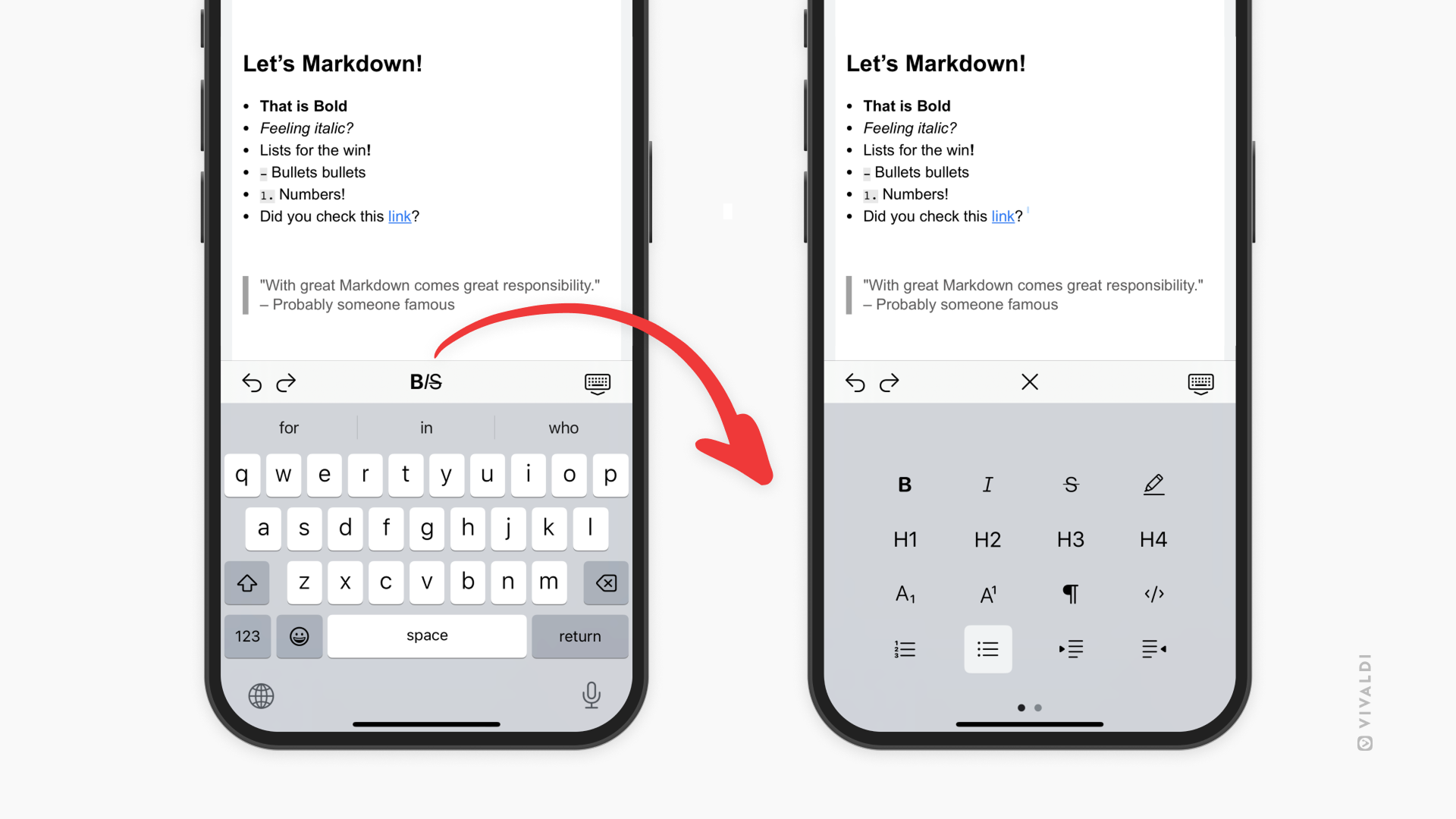
  3. View the formatted note by tapping on the Markdown button in the top right corner of the Notes Panel.
Option 2

  1. Start creating a new note or editing an existing one.
  2. Tap on the Markdown button in the top right corner of the Notes Panel.
  3. On the keyboard tap on B/S to open the formatting menu.
  4. Either select the formatting option before you start typing or select the text you want to format and then tap on the options in the menu.
Two iPhones with the Notes Panel open. An arrow points from the Markdown toggle button displayed on one phone, to the Markdown menu on the second phone.

Edit Notes

To edit a note:

  1. Tap on the note you wish to edit.
  2. Make the changes.
  3. Tap Done to save changes or Cancel to discard the changes.

Sort Notes

To change the order in which the notes are displayed:

  1. Open the Notes Panel.
  2. Tap on the 3-dot menu in the bottom left corner.
  3. Select Sort Order.

You can sort your notes:

  • Manually
  • By Title
  • By Date Created
  • By Date Edited
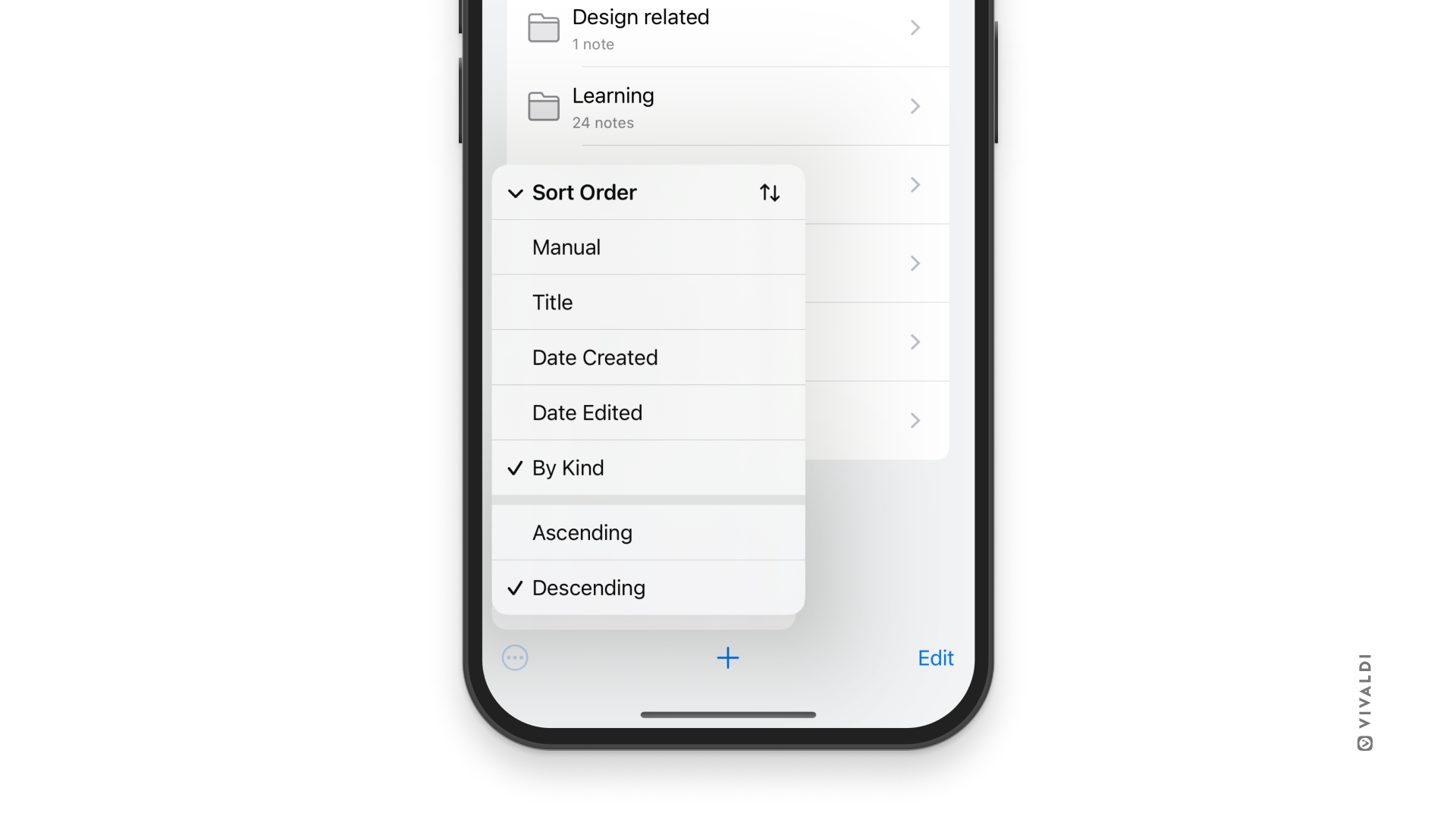
  • By Kind, which groups Notes folders to the top/bottom and sorts the rest of the notes using the manual order.

In addition, you can choose to sort notes either in ascending or descending order.

Vivaldi on iOS' Notes Panel with the sorting menu open.

Move notes

To move a note to a different folder:

  • Start editing the note you want to move.
  • Change the location of the note.
  • Tap Done.

Delete Notes

To delete a note, open the note and tap on Delete at the bottom of the Panel.

To delete multiple notes at once:

  1. In the Notes Panel, tap Edit in the bottom right corner.
  2. Tap on the notes you want to delete.
  3. Tap Delete in the bottom left corner.

Was this helpful?

Yes
No
Thanks for your feedback!

History in Vivaldi on iOS

View a list of websites you’ve visited in Vivaldi’s History Panel.

History Panel

Open the History Panel by tapping on the Panel toggle button Panel button on the left side of the bottom toolbar and tap on the History button History option on the menu.

The websites will be listed chronologically in descending order (most recent first). Tap on the entry to visit the page again.


Searching History

To search for a history item, tap on the Search button Search field and enter the search term.


Deleting History

To delete your browsing history:

  1. Open the History Panel and tap on  Clear Browsing Data in the bottom left corner.
    Alternatively, open Vivaldi menu button Vivaldi menu > Settings > Privacy and security > Clear browsing data.
  2. Pick a time range.
  3. Make sure the option for Browsing History is ticked.
  4. Tap Clear browsing Data.

To delete a single history entry:

  1. Open the History Panel.
  2. Long press on the entry you want to remove.
  3. Select Delete from the context menu.

Use Search to filter out the visited pages you want to delete.

Was this helpful?

Yes
No
Thanks for your feedback!

Bookmarks in Vivaldi on iOS

Learn how to save web pages as Bookmarks and manage them in the Vivaldi browser.

How to report a bug in Vivaldi on iOS?

In this article we’ve put together some guidelines that will help you write a good bug report for Vivaldi on iOS. A good bug report will help our developers reproduce and fix the bug.

Before reporting a bug

Before you report a bug, please try our troubleshooting suggestions and check the Forum‘s iOS category. Well-known bugs, updates and temporary workarounds are often discussed there.

If you can’t find anything about the bug you’ve encountered please file a bug report.


How to report a bug in Vivaldi on iOS?

  • Report each bug separately on vivaldi.com/bugreport/. Reports with more than one bug cannot be processed because each bug is allocated a unique bug tracker number.
  • Share information about the device’s brand, model and iOS version where the issue is occurring.
  • Describe the issue in as much detail as you can.
  • Add an exact link to a web page where the issue occurs, so it can be tested.
  • After reporting the issue, you will receive a confirmation email from the bug tracker with the bug number VIB-XXXXX, so make sure you give a valid contact email address.
  • You can add more information and files (e.g. screenshots) to the report by replying to the bug tracker’s email.

If you have questions about the bug please ask in the Forum first and do not forget to post the VIB-XXXXX bug number. Our helpful forum moderators will be able to help you.

Important! Please do not use the bug report page for support or other questions.

Thanks for helping us make Vivaldi better!


Report bugs through TestFlight

There are a couple of ways to report bugs to Vivaldi’s dev team directly through the TestFlight app.

Option 1

  1. Open the TestFlight app.
  2. In the app, open Vivaldi Browser’s profile.
  3. At the end of “What to Test” section, tap on “Send Beta Feedback”.
  4. Select whether you want to include a screenshot or not.
  5. If you chose to add screenshot to your bug report, select it.
  6. Enter your email address (optional).
  7. Describe the issue in detail with steps to reproduce the bug.

Option 2

  1. Long-press on Vivaldi Browser’s app icon on the home screen, in the app library or on the dock.
  2. Select “Send Beta Feedback” from the menu.
  3. Select whether you want to include a screenshot or not.
  4. If you chose to add screenshot to your bug report, select it.
  5. Enter your email address (optional).
  6. Describe the issue in detail with steps to reproduce the bug.

Was this helpful?

Yes
No
Thanks for your feedback!

Block Trackers and Ads in Vivaldi on iOS

Protect your browsing experience from web trackers and ads with Vivaldi on iOS’s Tracker and Ad Blocker.

Settings in Vivaldi on iOS

Learn how to access Vivaldi’s Settings, where you can customize the browser to match your preferences.

Search the web with Vivaldi on iOS

Search the web with your preferred Search Engines in Vivaldi on iOS.

Sync browser data on iOS

Sync bookmarks, password, open tabs and more between your desktop and mobile devices.

Error messages in Vivaldi on iOS

Sometimes browsing the web doesn’t go as planned and you end up looking at an error message instead of the web page you wanted to visit. Here are some of the messages you can encounter and suggestions for fixes.

No internet

This message is pretty self-explanatory. The web page couldn’t be loaded, because the browser wasn’t able to connect to the internet.

To fix the issue:

  • Check your Wi-Fi signal. If necessary, restart the router.
  • Check Mobile Data connection. You might be in an area without coverage or your mobile service provider is having issues.
  • Turn off airplane mode.

Aw, Snap!

This emotive message is shown when instead of loading the page, the web page crashes.

Often, simply reloading the page fixes the issue.

If that didn’t help:

  • Check your internet connection and when you’ve confirmed that you’re properly connected, reload the page.
  • If the page opens without issues in a Private Tab, delete the browser‘s cache and reload the page.
  • Close other tabs and apps.

Was this helpful?

Yes
No
Thanks for your feedback!