History

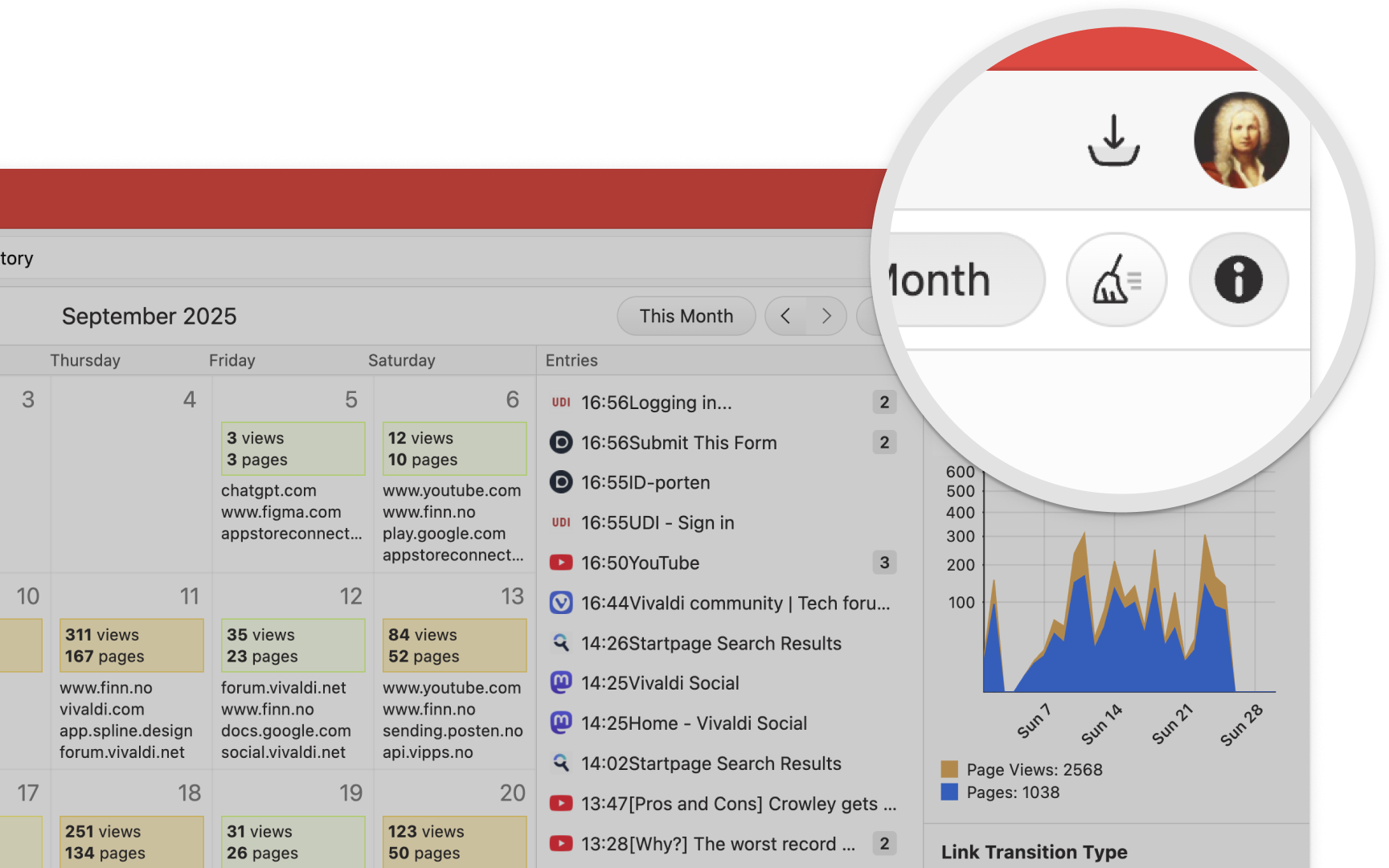
The History tool in Vivaldi is somewhat different than in a typical browser – instead, Vivaldi’s History is a detailed overview backed by statistics and presented in a fresh, visual way. It was built to give users a powerful and useful tool to explore their browsing patterns and to make finding previously visited sites easier than ever.
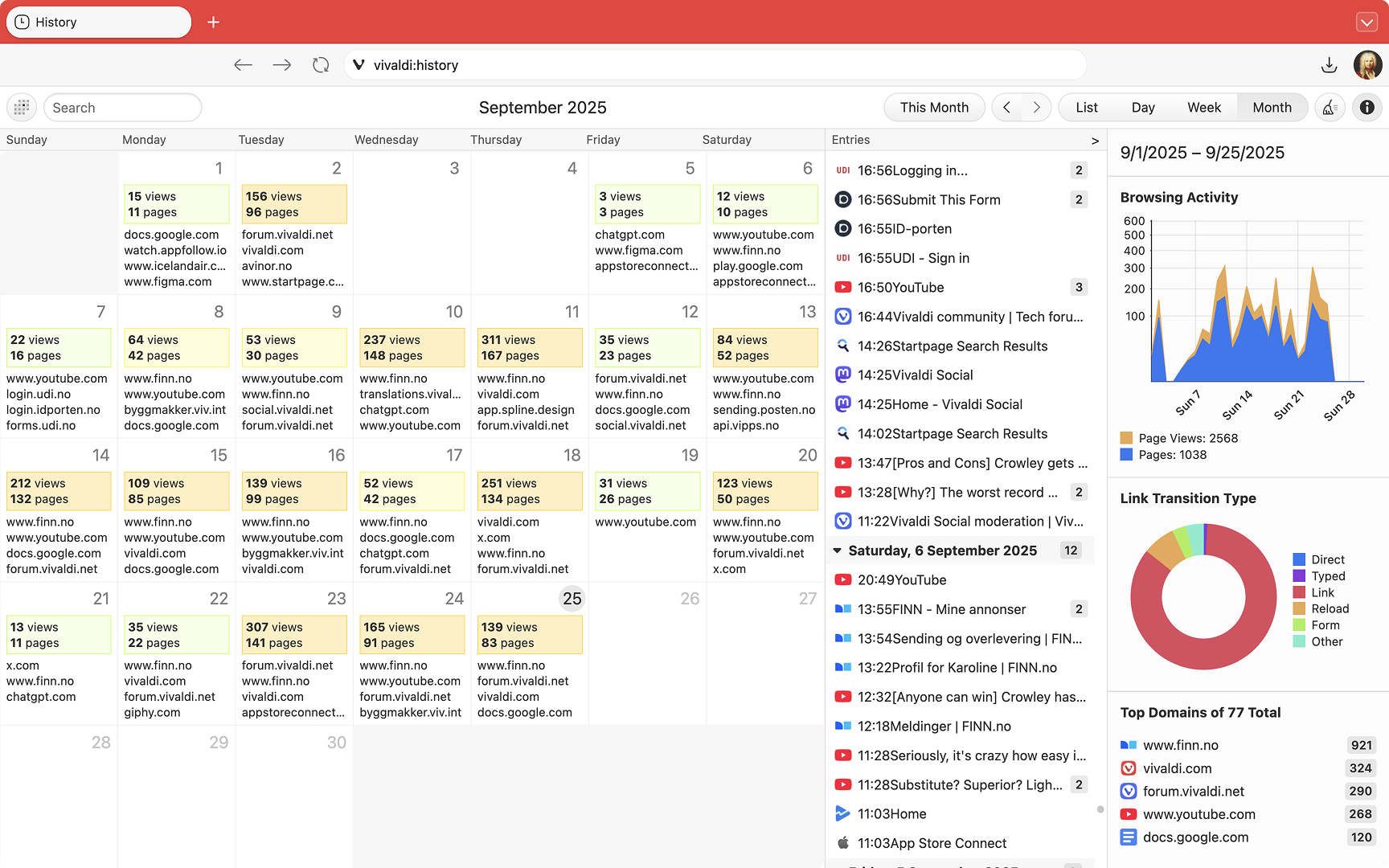
Browsing History in Vivaldi

Accessing History

To open the History page:


Searching visited pages

To search specific History entries, enter the page’s title or URL in one of the following places:

  • History Manager’s search field in the top left corner of the page.
  • History Panel‘s search field at the top of the panel.
  • In the Address Field, type “@history” followed by a space and your search keyword to see results only from History.

Using History in Vivaldi

History offers a number of different views and ways to filter your browsing history data in Vivaldi. Get an overview and a few examples with the video below:


Delete browsing history

Clearing browsing data can be done from the History page by clicking the Clear Browsing Data button in the top-right of the History page.

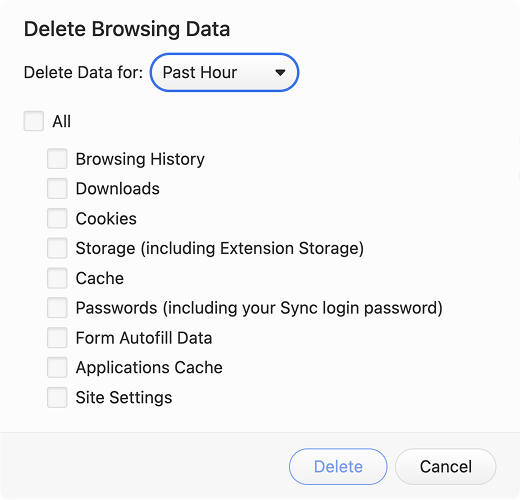
Alternatively, open the Delete Browsing Data window:

  • From Vivaldi menu button Vivaldi menu > Tools > Delete Browsing Data;
  • By clicking the Clear Browsing Data button in the top-right corner of the History Panel;
  • By typing “Delete Browsing Data” in Quick Commands;
  • Using the Keyboard Shortcut Ctrl Shift Del / ⇧ ⌘ ⌫;
  • Creating a Mouse Gesture for the action.
Clear browsing data in Vivaldi browser

Select:

  • The time range
    • Past Hour
    • Past Day
    • Past Week
    • Past 4 Weeks
    • Everything
  • Which elements of the stored browsing data to delete
  • And confirm by clicking Delete.
Clear Private Data menu in Vivaldi

History Retention

You can decide for how long your browsing history is saved in Vivaldi.

To review and change the time:

  1. Go to Settings > Privacy and Security > Privacy > Save Browsing History.
  2. Choose between:
    • Session Only – meaning your history will be deleted every time you exit the browser.
    • One Day
    • One Week
    • One Month
    • Three Months (the default)
    • Six Months
    • One Year
    • Forever
  3. Restart the browser.

Privacy

History data is strictly private and stored locally to individual Vivaldi installations – Vivaldi Technologies does not collect any History data from browser users. Find out more about Vivaldi’s Privacy policies and terms here.
Was this helpful?

Yes
No
Thanks for your feedback!

Uninstall Vivaldi on Windows 10

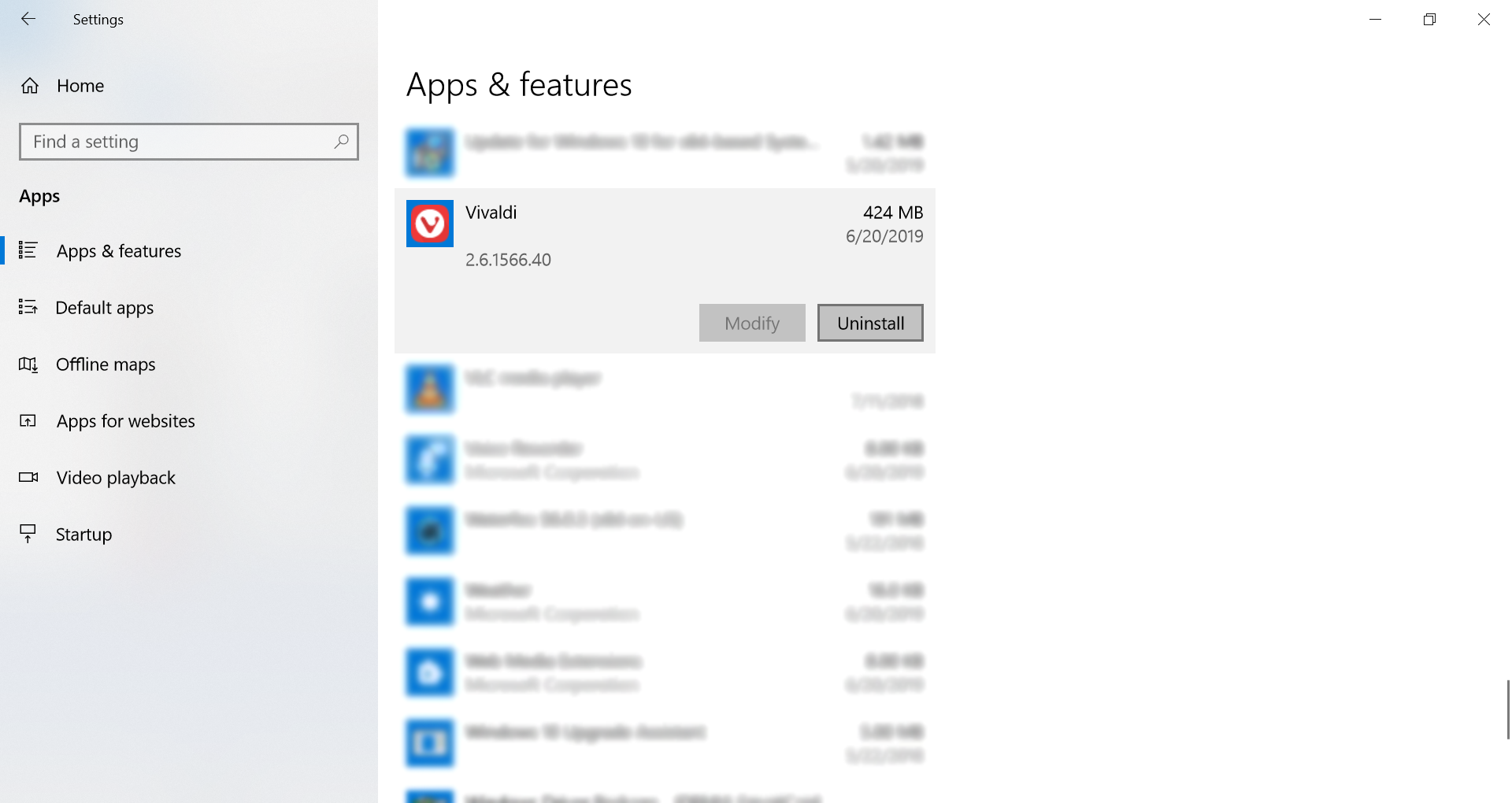
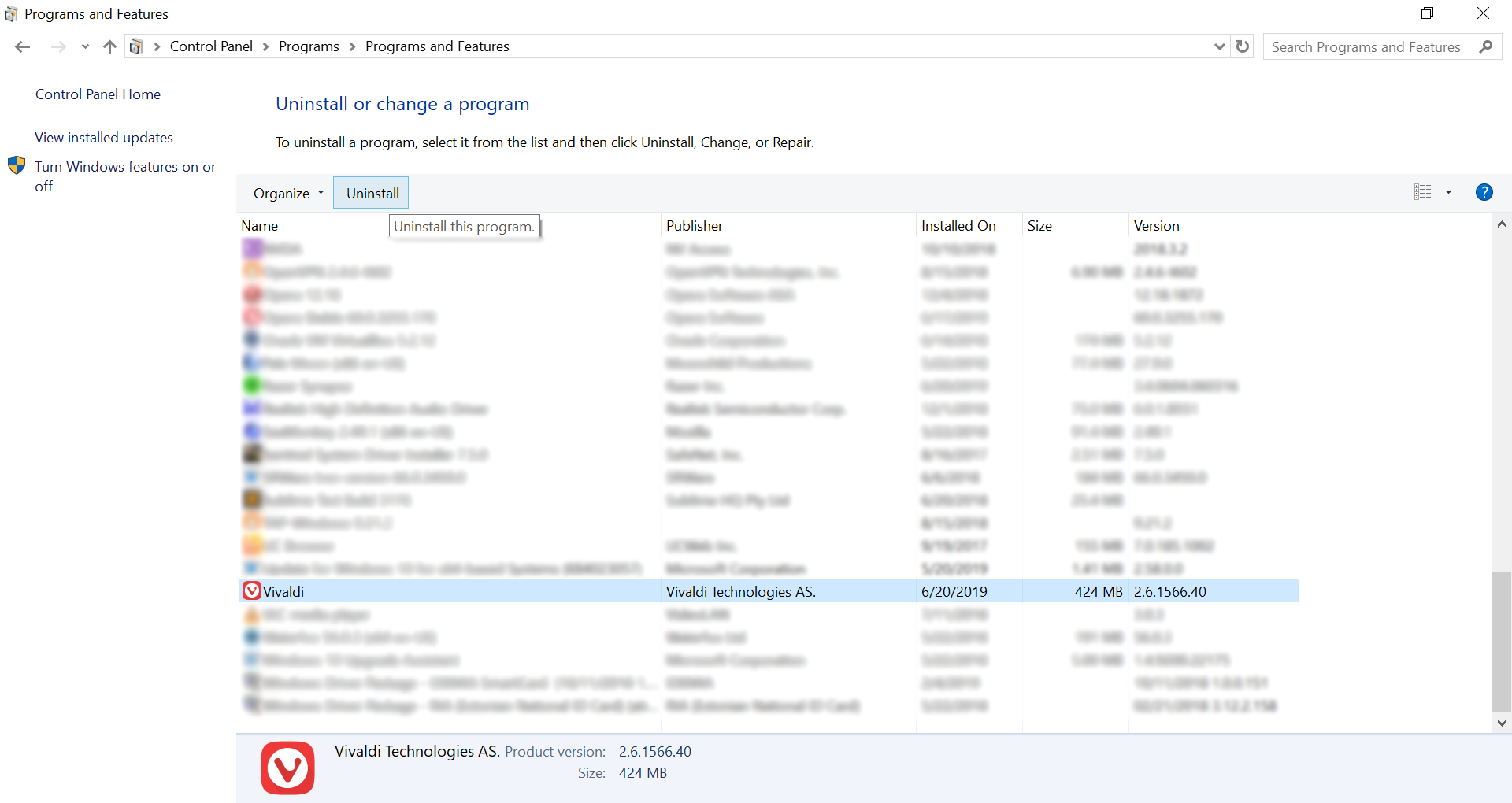
If you have issues uninstalling Vivaldi while using Windows 10, Windows 10 provides two different UIs to add/remove programs: the old style UI, and a new modern look (see screenshots below).
Only the older style UI will allow a non-admin user to uninstall a single user installed program.

Uninstall Vivaldi on Windows 10's old UIOlder add/remove program Windows UI

Uninstall V on Windows 10's new UINew add/remove programs UI in Windows 10.
 

To uninstall Vivaldi from Windows 10, make sure that you are using the old add/remove UI.
To ensure that you are, follow these steps:

    1. Use ⊞ WinKey+R to open the Run dialog,
    2. Type: control appwiz.cpl,
    3. Press OK,
  1. Scroll down to the “Vivaldi” entry and double click it.

Alternatively, you can also uninstall the browser by using the setup.exe we include with Vivaldi and calling it directly, e.g. assuming the version number is 1.7.735.29, start the run dialog and then issue the following:

%LOCALAPPDATA%\Vivaldi\Application\1.7.735.29\Installer\setup.exe --uninstall --vivaldi

If you still run into issues when attempting to uninstall Vivaldi from Windows 10, please get in touch with our support team on vivaldi.com/contact.

Other operating systems

If you use macOS, Linux or another version of Windows, head here for instructions on how to uninstall Vivaldi.


Was this helpful?

Yes

No


Thanks for your feedback!

Capture a Screenshot

Vivaldi’s built-in Capture tool lets you capture either a Full Page screenshot, or a Selection of the screen that you define. It can be accessed in a number of ways through the Vivaldi UI to give you flexibility in how you implement the tool.

Types of Capture

Full Page

A Full Page capture is a screenshot of the full length of a website (max 30 000 pixels). Whether you’re giving feedback on a design, gathering inspiration, or just want to share an interesting site with a friend, this is a great way to get a bird’s eye view in a single image.

Selection

Capturing a Selection lets you focus in on a particular piece of your screen for more precision. After doing an initial selection, you can resize the capture area, before taking the screenshot.


Output of Capture

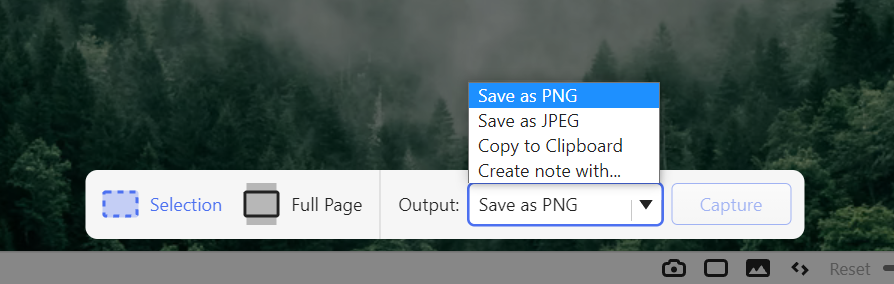
Whether capturing a Full Page or a Selection, you can choose to save the new snap to your disk for later use, or copy it to your clipboard to share it instantly.

Save to Disk

In the Capture tool you are given options to “Save as JPEG” or “Save as PNG“. When choosing these options, your new screenshot will be saved immediately to your local disk.

Copy to Clipboard

A newly captured screenshot can be copied as an image to your system’s clipboard. This makes it easy to share your new screenshot in other applications and documents immediately; once a screenshot is copied to your clipboard, simply Paste in place to insert the image into the desired location.

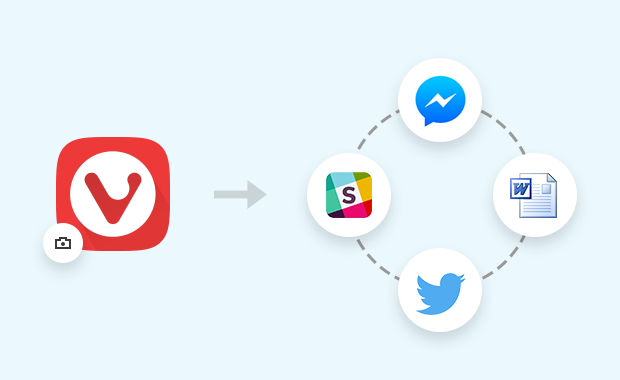
Share captured screenshot on other apps

Create a new note from the capture

When you save the capture as a note, the screenshot will be saved with the capture date and page URL. The note won’t have a title or any text content, so go to the Notes Panel or Notes Manager to add it.


Access the Capture tool

Vivaldi lets you choose how to use its features, giving you several ways to get something done. Capturing screenshots is no exception. Below we describe the ways which you can access the Capture functionality in your browser.

Status Bar

Capture can be accessed in your Status Bar via the camera icon. Clicking on the icon will bring up your options for capturing a new screenshot: Full Page vs Selection, “Save as…” and “Copy to Clipboard“.

Capture menu

Keyboard Shortcuts

Capture functionality can be activated using Keyboard Shortcuts in Vivaldi. This means that pressing a pre-defined combination of keys will fire the associated action (e.g. capturing a Selection screenshot).

To map a custom keyboard shortcut to your preferred Capture method open your Settings and search for “Capture”. The available actions that can be mapped to a keyboard shortcut will display in the search results.

Click into the action you’d like to work with, and type your custom shortcut. The command is available immediately.

Notes

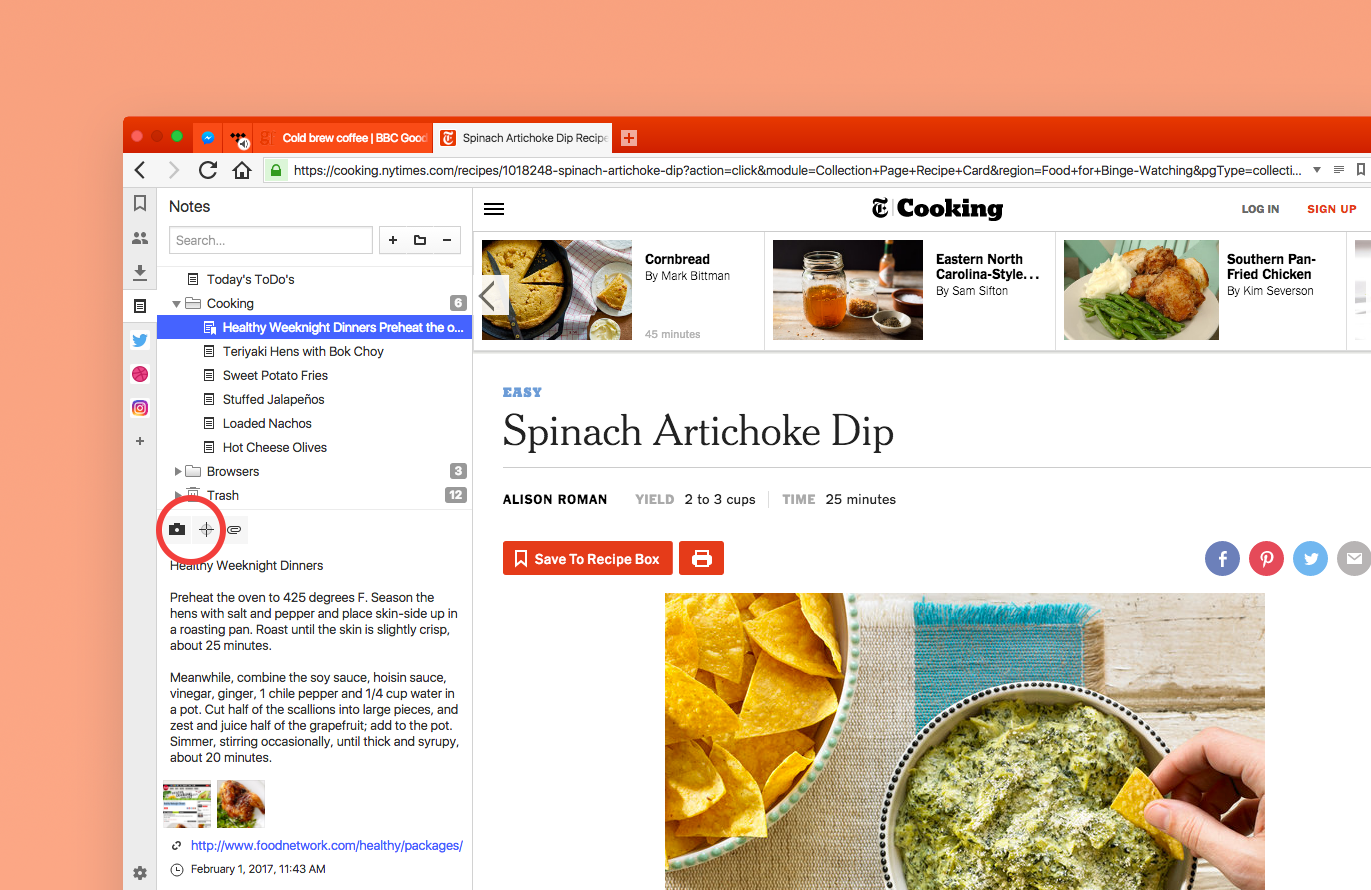
Vivaldi has a built-in Notes tool which allows you to capture thoughts and ideas while you browse. The Capture tool is integrated directly in the Notes Panel, allowing you to attach screenshots to your notes.

take-screenshots-in-notes

Quick Commands

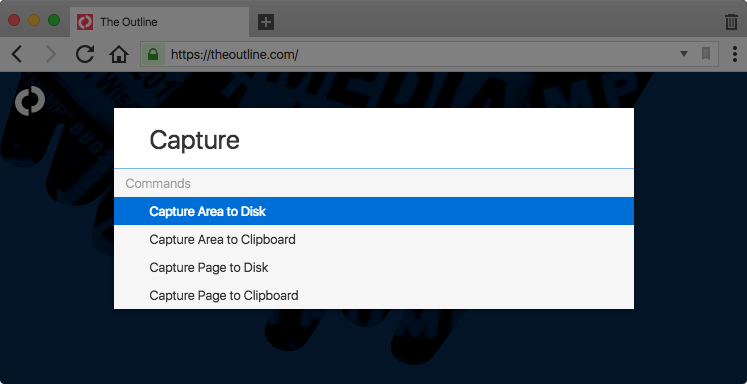
Quick Commands is a tool for users that like to keep their hands on the keyboard. To access the Capture tool via Quick Commands:

  • Open Quick Commands by pressing F2 / ⌘ E.
  • Enter “Capture” to filter the list of available commands.
  • Use arrow keys to navigate the list of Capture commands.
  • Press Enter to issue selected command, or
  • Close Quick Commands by pressing Escape key.
capture-quick-commands

Change the location of saved captures

When you select the option to “Save as PNG” or “Save as JPG“, your capture will be stored at the directory specified in Settings. The location where your captures will be saved can be edited in Settings > Webpages > Image Capture > Capture Storage Folder.

Naming the Capture

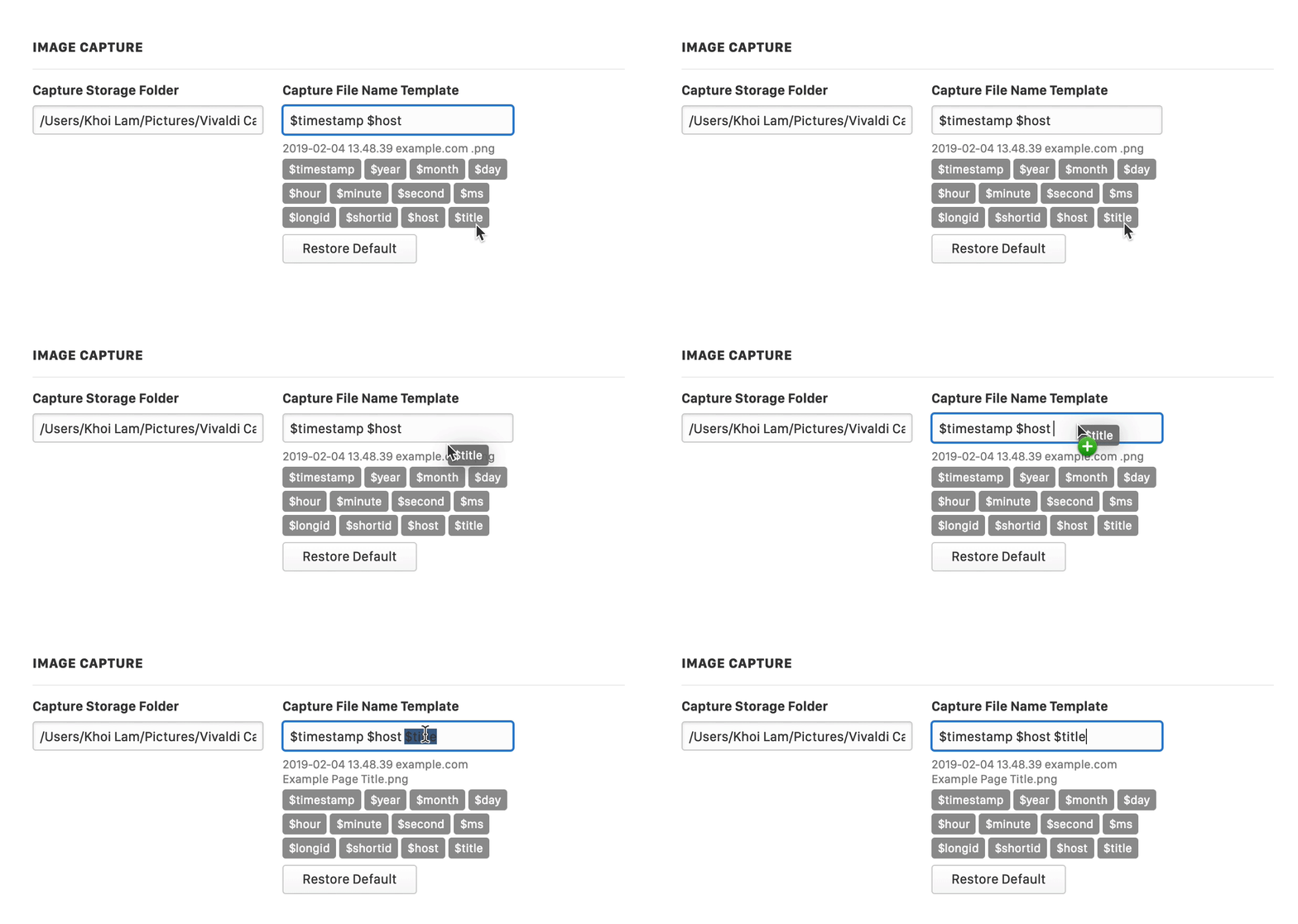
Captures will be named automatically, but you can define the format in Settings > Webpages > Image Capture > Capture File Name Template.

Animation showing the changing of capture name template

Was this helpful?

Yes
No
Thanks for your feedback!

Group tabs into Tab Stacks

Tab Stacks are a great way to keep things tidy on your Tab Bar when you have a lot of tabs open.

Preview Tabs

Previewing tabs lets you find the page you’re looking for easily by showing you a screenshot of the page in a thumbnail.

Pop-up thumbnails

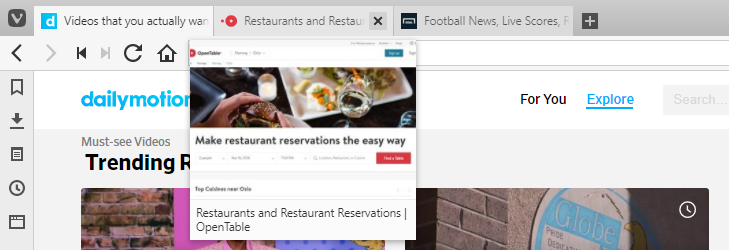
To preview a tab, move your mouse pointer over the tab in the Tab Bar. A visual preview of the tab’s contents will appear below. This feature can be enabled/disabled in Settings > Tabs  > Tab Display > Tab Options > Show Pop-up Thumbnails.

Pop-up thumbnails for Tab Stacks

When you’ve grouped tabs into a Tab Stack, hovering over the stack on the Tab Bar will show you the thumbnails for all tabs in the stack. You can close tabs from there and drag tabs out of the stack to the Tab Bar or new Window. Alternatively, right-click on the thumbnail and select Close Tab or Remove from Tab Stack from the context menu.

Tab Preview image on hover

Tab Bar thumbnails

To enable or disable more permanent tab previews:

  • Go to Settings > Tabs  > Tab Display > Tab Options and toggle Show Tab Thumbnails on or off.
  • Type “Tab Thumbnail” in Quick Commands.
  • Create a Keyboard Shortcut or Mouse Gesture for the action.
  • Place the mouse pointer on the edge of the Tab Bar, where it changes into a double ended arrow. Then drag (like shown on the gif below), double-click or middle mouse button click to show and hide tab thumbnails. For this option to work, Show Tab Thumbnails needs to be enabled in Settings.
How to show tabs thumbnails

Was this helpful?

Yes
No
Thanks for your feedback!

Full reset of Vivaldi

In this article we’ll show you how to backup your data and fully reset the Vivaldi browser.

IMPORTANT This article is for advanced users. Following the steps described here will result in losing all your Vivaldi data (Notes, Bookmarks, Web Panels, etc.) and settings, such as cache, history, themes and so on.

If you want to continue and fully reset Vivaldi, please make sure you have a backup of your data before you proceed.


Backup Vivaldi data

One option to back up some of your data is to Sync the data with other devices you use Vivaldi on. That way when the data is deleted on one device you can still access it on others and sync it back after the reset.

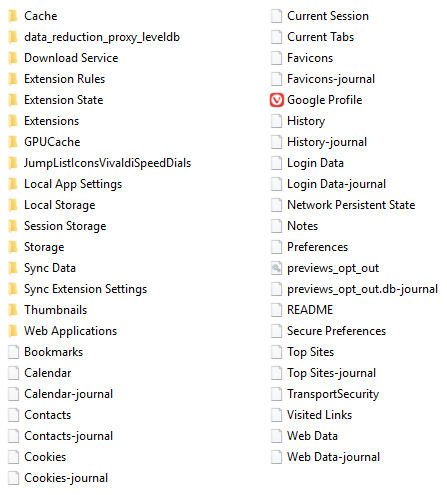
Alternatively, you can make a backup of the profile folder (follow the Profile Path on vivaldi://about), which includes some key elements of your Vivaldi setup, such as preferences, profile and settings. Most of the key components are stored within the Default folder, though you should also retain the First Run file stored alongside it. Deleting this file will make Vivaldi assume it is starting up for the first time.

Overview of Vivaldi's folders

Here are some of the key elements stored under the Default folder:

Bookmarks contains bookmarks and information from Speed Dials.
Notes notes taken in the Notes Panel.
Sessions –  saved tabs sessions.
Login Data website passwords. Note: This file is encrypted and is only usable on the machine that created it.
Preferences and Local App Settings\mpognobbkildjkofajifpdfhcoklimli – Vivaldi settings and configuration.
Web Data – autofill data.
Current Session – data on open tabs.
History – website history.
Cookies – website data.
Extension Rules, Extension State, Extensions, Local Extension Settings, Local Storage, Managed Extension Storage, Extension Cookies and Secure Preferences – all extension preferences and extension data are stored here.

Make a copy of the Default folder and First Run file and paste them, for example on your Desktop or Documents.


How to reset Vivaldi settings

  1. Go to vivaldi://about.
    Alternatively, open Vivaldi menu button Vivaldi menu > Help > About
  2. Make a note of the directory listed under Profile Path.
  3. Open a system window (File Explorer).
  4. Go to the User Data folder.
  5. Once you’ve located the correct folder, close the browser.
  6. In the system window delete the entire User Data folder.
  7. Start Vivaldi.

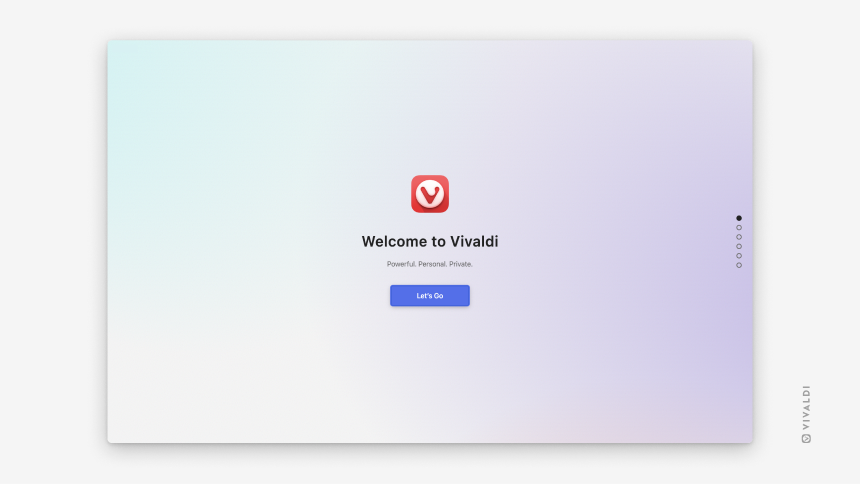
If you have completed the steps successfully, you will see the first step of the welcome tour as you start Vivaldi.

First page of the Welcome Tour after browser installation or full reset.

Was this helpful?

Yes
No
Thanks for your feedback!

Zoom options in Vivaldi

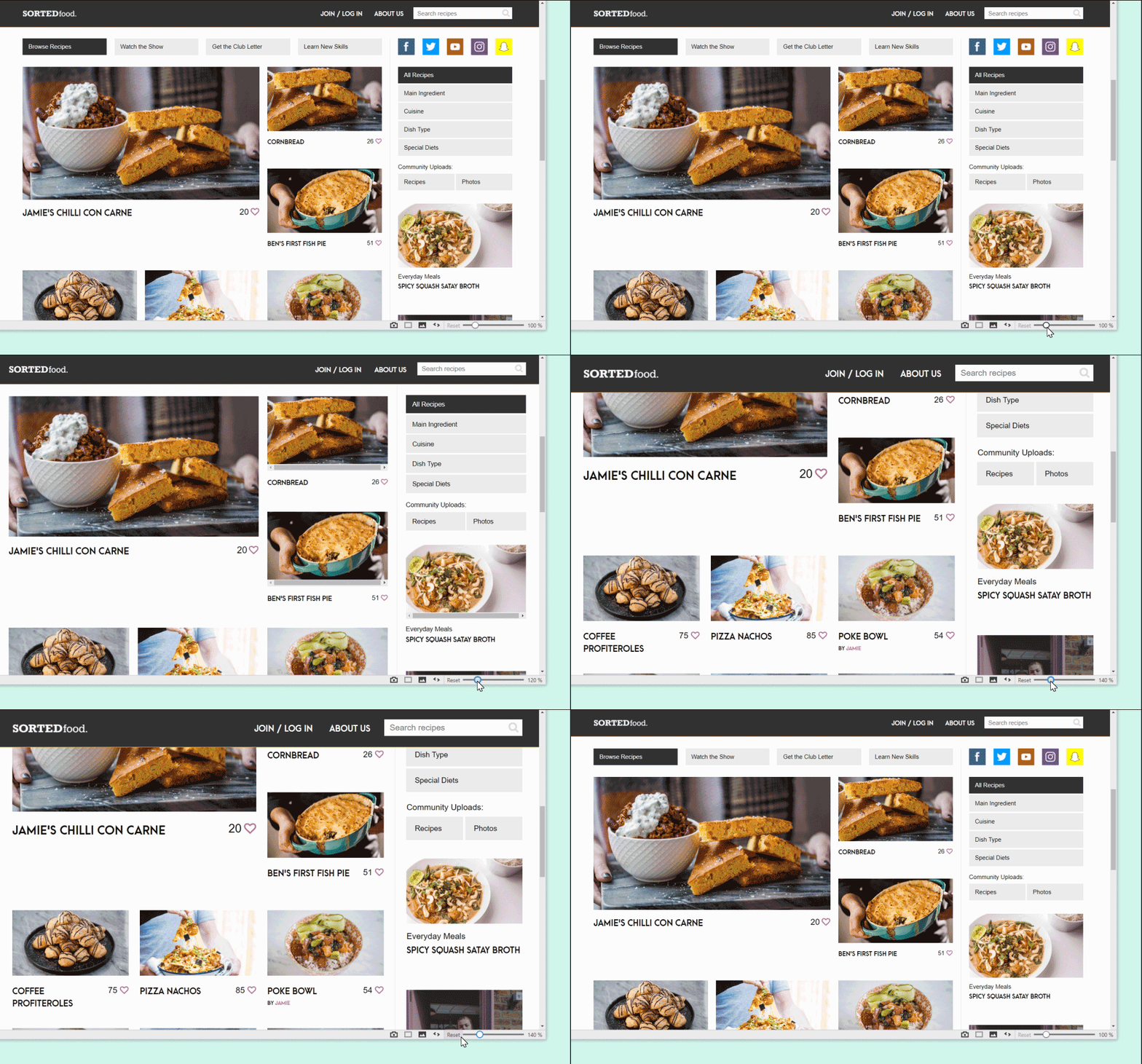
There are many ways to adjust the zoom in Vivaldi.

Zoom with the slider on the Status Bar

Drag the slider on the Status Bar to the right to zoom in and to the left to zoom out the active page. Click Reset to revert zoom to the default value.

You can switch the slider for buttons in Settings > Appearance > Window Appearance by ticking the box for Use Buttons in Range Controls. This will affect all range controls in the browser UI.

Zooming using the slider animation

Zoom with keyboard shortcuts

Use the Ctrl + / ⌘ + Keyboard Shortcut to zoom in and Ctrl - / ⌘ - to zoom out of a page. The shortcuts can be edited in Settings > Keyboard > Shortcuts.

Alternatively, focus on the zoom slider on the Status Bar and use the arrow keys to change the zoom level by 10% increments or the Page Up and Page Down keys to change the zoom level by 50%.

Pressing Home or End while the slider is focused will zoom the page to the minimum or maximum value (respectively).

To reset zoom to the default value, use the shortcut Ctrl + 0 / ⌘ 0.

When you’ve enabled Single Key Shortcuts, you can zoom in and out by pressing the following numbers either above the letters on the keyboard or on the number pad:

  • 0 – zoom in by 10%
  • 9 – zoom out by 10%
  • 8 – double the zoom level
  • 7 – halve the zoom level
  • 6 – reset the zoom level

Zoom with a mouse scroll

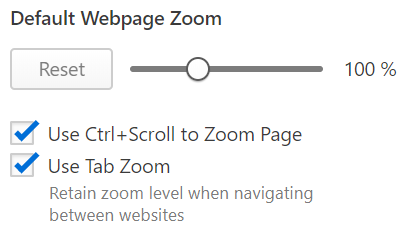
When Use Ctrl/⌘ + Scroll to Zoom Page is enabled in Settings (see image below), hold down the Ctrl / key and use the mouse scroll to zoom. On a touchpad hold down the same key and with two fingers slide either up or down.

When Use Ctrl/⌘ + Scroll to Zoom Page is disabled, then using the pinch zooming gesture on the touchpad, instead of rearranging the page and increasing font and other element sizes, will create an effect similar to using a magnifying glass (sometimes referred to as pinch-to-zoom).

Another option is to hover over the zoom slider on the Status Bar and use your mouse scroll or two finger slide on the touchpad to zoom.


Zoom from the Vivaldi menu

From menu (on Windows and Linux) > View select whether you want to zoom the page in or out, or reset the zoom to the default value.


Zoom every page from settings

Change the default zoom level of every page you visit by using the range control in Settings > Webpages Default Webpage Zoom.

Zoom settings

Website Zoom vs Tab Zoom

When Use Tab Zoom is enabled in Settings > Webpages Default Webpage Zoom, the zoom level will stay the same on all the websites you visit in that tab. The same website open in different tabs can have different zoom levels.

When Use Tab Zoom is disabled each site you visit in the tab can have a different zoom level. When you open the same website in a different tab or at a different time, it will be displayed at the zoom level you set for the site in the other tab.


Zoom in Web Panels

To increase or decrease the size of the content in Web Panels:

  1. Right-click on a Web Panel.
  2. Select Navigation Controls > Display Zoom Controls from the context menu.
  3. Then click on the zoom buttons  and  at the top of the Web Panel to zoom in and out.
Zoom level is retained through closing and reopening of the Web Panel and browser restarts.


Zoom the user interface

Change the default zoom level by using the range control in Settings > Appearance > User Interface Zoom.


Text Zoom

To increase the text font size on web pages:

  1. Go to Settings > Webpages > Fonts.
  2. Change the Minimum Font Size.

Was this helpful?

Yes
No
Thanks for your feedback!

Flash Player for Vivaldi

From the beginning of 2021, Flash Player is no longer supported. For more information, please visit Adobe Flash Player’s end of life general information page.

Was this helpful?

Yes
No
Thanks for your feedback!

Fast Forward & Rewind

Fast Forward

When a website has paginated content, instead of scrolling to the bottom of the page and clicking on the next page button on the web page, you can click on the Fast Forward button on the Address Bar to load the next page.

Fast Forward works, for example, on Search Engines‘ search results pages, forum topic lists pages, online (shopping) catalogues, etc.

Alternatively, you can use the Space key. Pressing Space on your keyboard will move you down the page bit by bit and once you’ve reached the end of the page, it’ll load the next page.

Rewind

Go back in one click to the first page if you’ve browsed several pages on a same website.

For example, if you visit a Search Engine site such as DuckDuckGo or Ecosia and search for something. You look for it on Page 1, then Page 2 and then Page 3, etc. Let’s say you are on Page 5, by hitting Rewind button, you can return straight back to Page 1 in a single click.

Fast forward and Rewind buttons

Tip

Fast Forward and Rewind can be accessed from the main tool bar as well as through Keyboard Shortcuts and Mouse Gestures.

Was this helpful?

Yes
No
Thanks for your feedback!

Saved Sessions

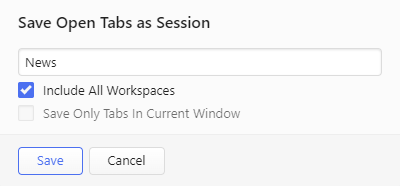
Vivaldi allows you to save your current open tabs as a named “session” and access them again later. This allows you to open the set of tabs included in a session with one click whenever you need or when the browser starts.

Saving a session

To save all open tabs in either one or multiple windows as a session, either:

To save only some tabs as a session, use the Ctrl/⌘/Shift key to make a selection and:

  • Right-click on one of the selected tabs and select Bookmark and Save > Save as Session from the context menu.
  • Type “Save Selected Tabs as Session” in Quick Commands;
  • Create a Keyboard Shortcut or a Mouse Gesture for the action.

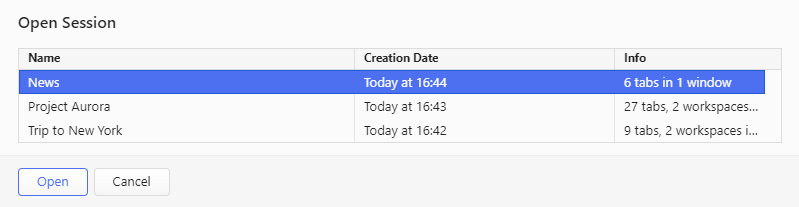
Opening a saved session

To open a saved session:


Sessions Panel

A convenient and powerful way to manage your Sessions is using the Sessions Panel. Learn how to use it here.

Was this helpful?

Yes
No
Thanks for your feedback!